
Latest Version
Duke University Computer Science Department
Education
Linux
Free
org.jflap.JFLAP
Report a Problem
More About JFLAP
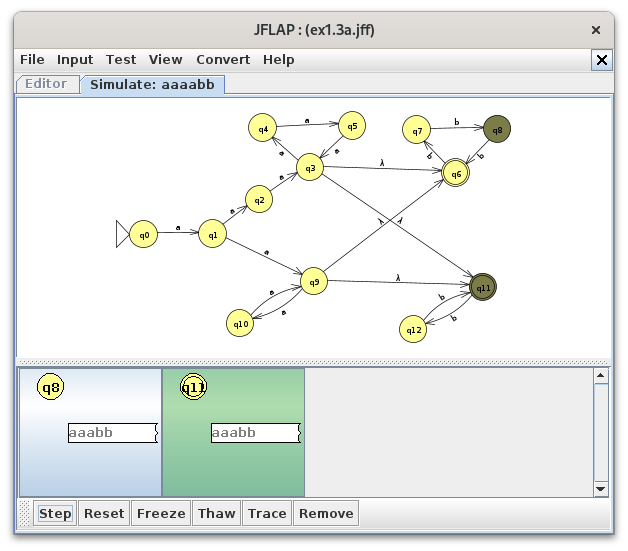
Imagine sitting in a computer science lecture, struggling to visualize how a nondeterministic finite automaton transitions between states, or trying to trace the complex paths of a multi-tape Turing machine on a static piece of paper. The JFLAP formal languages testing suite turns these abstract, theoretical concepts into highly interactive, visual demonstrations that make learning intuitive.
What is JFLAP?
JFLAP is a highly specialized educational software package designed for academic experimentation with formal languages and automata theory. Developed under the umbrella of the Duke University Computer Science Department, this tool serves as a virtual laboratory where students and educators can construct, test, and analyze complex mathematical models. It bridges the gap between raw mathematical theory and visual comprehension.
Key Features of JFLAP Formal Languages Testing
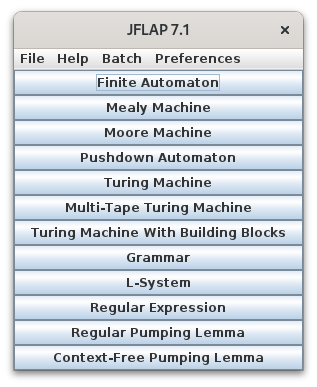
This platform offers an extensive suite of tools tailored for computer science curricula:
- Automata Simulation: Design and run input strings through nondeterministic finite automata (NFA), deterministic finite automata (DFA), and pushdown automata.
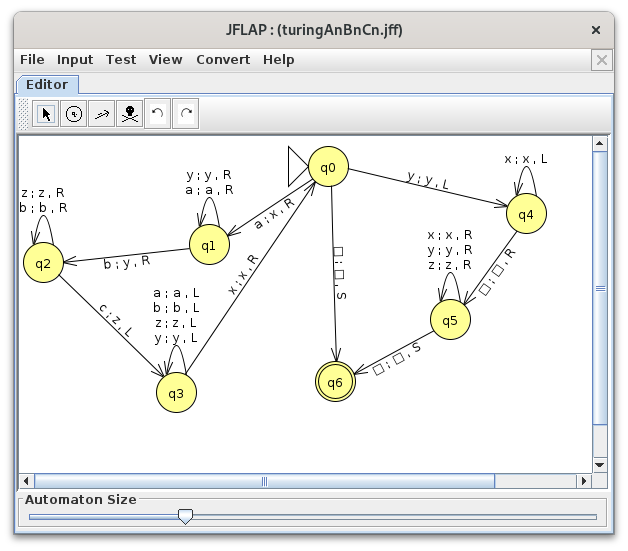
- Turing Machines: Build and visualize advanced multi-tape Turing machines to understand computational limits.
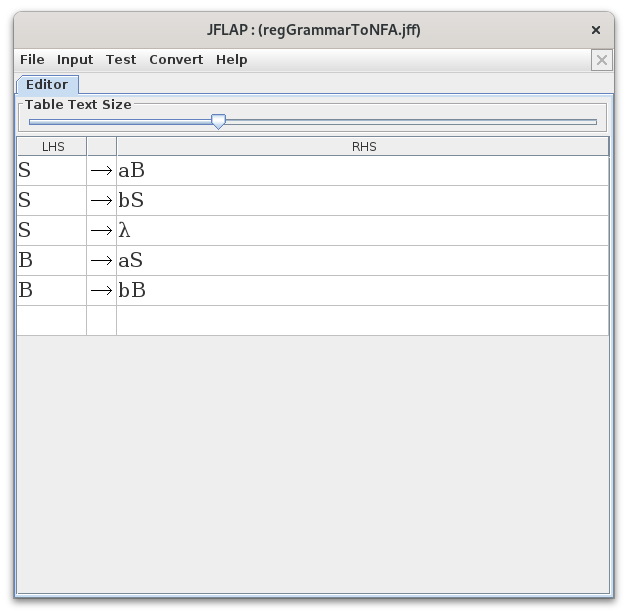
- Grammar & Parsing: Experiment with various grammar types and step-by-step parsing algorithms.
- L-Systems: Create and render beautiful, mathematically-driven fractal structures using Lindenmayer systems.
- State Conversion Proofs: Convert an NFA to a DFA, minimize states, and transform regular expressions into regular grammars with interactive step-by-step guidance.
Who is This Software For?
The JFLAP formal languages testing tool is indispensable for undergraduate and graduate computer science students tackling theory of computation courses. It also serves as an invaluable classroom aid for professors who want to demonstrate state transitions and algorithmic proofs in real time rather than drawing static diagrams on a whiteboard.
Important Community Note
This specific iteration is maintained as a community-packaged version for Linux platforms (available via Flathub). While it provides a seamless installation experience for modern Linux distributions, users should note that it is not officially supported directly by the Duke University Computer Science Department, though official jar files remain hosted on their academic portal.
An Essential Tool for Computer Science Scholars
If you are looking to master the complexities of automata theory and formal grammars, having a visual simulation tool is a game-changer. To explore this educational resource and integrate it into your study routine, check out the official distribution page on Flathub today.
Rate the App
User Reviews













Popular Apps










Editor's Choice